
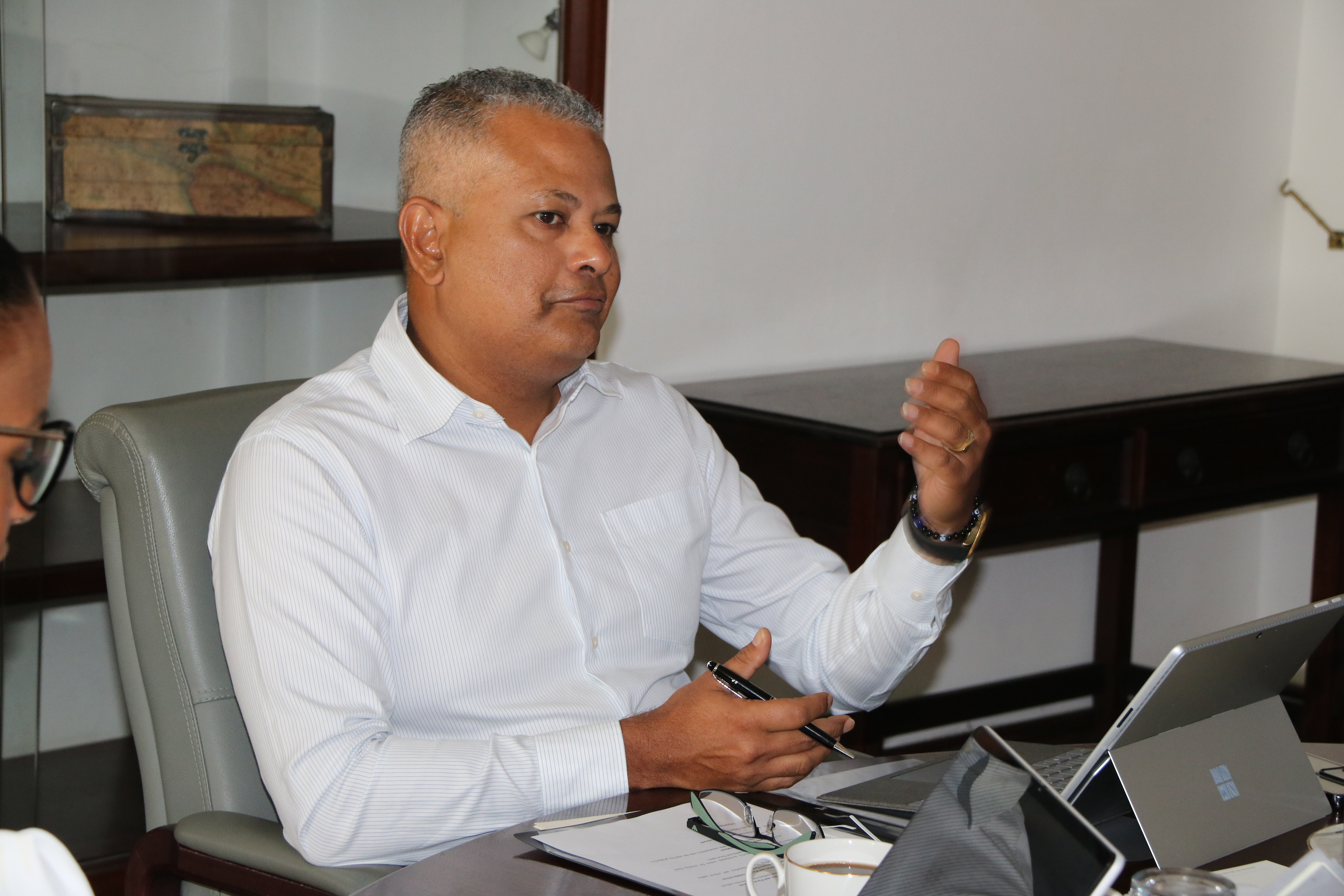
Vice President Mr. Sebastien Pillay, on behalf of President Dr. Patrick Herminie, chaired the fifth session of the Presidential Economic Advisory Council (PEAC) today, focusing on Seychelles' fiscal outlook, debt sustainability and the financing of critical infrastructure projects.
Secretary of State for Finance Mr. Patrick Payet presented the Government's Economic and Fiscal Outlook for 2026–2030, outlining economic growth projections, public finances, debt developments and planned investments.
The presentation highlighted significant infrastructure requirements, including the proposed new national hospital, port expansion and rehabilitation, airport redevelopment, and investments in public utilities and renewable energy, several of which have yet to be incorporated into the medium-term fiscal framework.
A central focus of the discussions was the existing debt-to-GDP target of 50%, with several Council members expressing concern that the target constrains Government's capacity to finance critical infrastructure. Members proposed examining greater flexibility within the debt framework to accommodate productive investment, while safeguarding long-term fiscal sustainability.
The Council emphasised that debt sustainability should not be assessed solely on the basis of the debt-to-GDP ratio, but through a broader range of economic and fiscal indicators, including debt-servicing capacity, Government revenue, borrowing costs, economic growth prospects and resilience to external shocks. Members stressed that any additional borrowing must be supported by a credible financing and repayment strategy, demonstrating the expected economic returns and a sustainable debt trajectory.
In this context, members proposed the development of a comprehensive, long-term economic growth and investment framework extending beyond the traditional five-year planning horizon. Discussions also highlighted the importance of tax and institutional reforms, improving the ease of doing business, strengthening private sector investment and exploring alternative infrastructure financing mechanisms.
Members further underscored the interconnected nature of fiscal policy, monetary and financial stability, and the wider economy, highlighting the need for a coordinated approach to economic planning and development.
In his closing remarks, Vice President Pillay reiterated the Government's ambitious development agenda, extending beyond the current five-year period. He emphasised the Government's commitment to creating greater opportunities for the private sector to invest, expand and contribute more meaningfully to economic growth. He further underscored the importance of harnessing private sector investment and economic development to advance the country's long-term development priorities and social transformation agenda, while maintaining fiscal and financial stability.