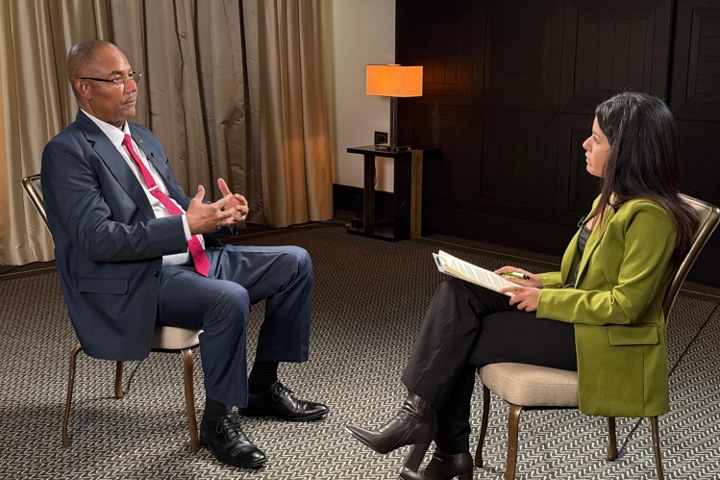
As part of his working visit to Moscow, the President of the Republic of Seychelles, Dr Patrick Herminie, was interviewed by the Russian Television (RT). The discussion focuses on Seychelles’ foreign policy, the past, present and future relations with Russia, and how the ongoing war in the Middle East is affecting global energy stability.
The President also highlights the impact of climate change and the external pressures facing Small Island Developing States (SIDS).
RT: What achievement in your country’s relations with Russia are you most proud of?
President Herminie: One of the achievements I am most proud of is the way Seychelles has built strong partnerships that directly benefit our people.
For example, this year we celebrate 50 years of diplomatic relations with Russia. In the early years, after Independence in 1976, Russia offered many scholarships to Seychellois students. Those who studied abroad returned home qualified in medicine, engineering, education, and other fields, and their contributions have been vital in building our nation. Russia has also provided humanitarian support, Covid 19 (Spunik V) vaccines, training and exposure for Seychellois athletes.
For a small island like Seychelles, such relationships expand opportunities beyond traditional allies and they help develop skills, talent, and global exposure. They strengthen resilience by avoiding overdependence on a single partner.
RT: How has the conflict between the U.S and Iran affected your country, and how long will the consequences of this conflict continue to be felt?
President Herminie: Like every country in the world at the moment, Seychelles is also facing consequences, even though it is geographically far away.
Fuel Prices and cost of living; About 20 percent of global oil passes through the Strait of Hormuz. The current conflict and blockades are disrupting supply and pushing prices up globally. As a result, the country has increased a small percent of its fuel price. A day coined as Energy Conservation Day, for reducing the cost of energy consumption, has also been implemented.
Impact on Tourism and air connectivity; Emirates and other airlines from the Middle East have reduced their flight frequency, hence fewer visitors in the country.
Security risk in the Indian Ocean; The conflict is not staying confined to the Middle East. Tensions have spread into the wider Indian Ocean. Increased naval activity and rerouted shipping raise risks.
Broader economic pressure; For small island economies like Seychelles higher import bills strain government budgets, foreign exchange reserves come under pressure, economic growth can slow down.
To conclude, even without direct involvement, Seychelles is vulnerable because it is deeply connected to a global system. However, Seychelles has built a reputation for resilience, and our policy approach is focused on adaptation, diversification, and maintaining macroeconomic stability.
RT: Members of the Seychelles National Assembly says they want as many Russians as possible to visit and experience the Seychelles culture. Can Russian tourists expect any sort of special benefits?
President Herminie: The Seychelles warmly welcomes Russian visitors, who have become an increasingly valued part of our tourism family in recent years.
Russian tourists already benefit from Seychelles’ visa-free entry, making travel to our islands simple and accessible. Beyond this, we are continuously working with industry partners to better cater to the preferences of the Russian market through enhanced air connectivity, closer collaboration with Russian tour operators, and the availability of Russian-language services within the destination.
While Seychelles does not differentiate in terms of exclusive benefits, our focus is on creating meaningful and memorable experiences tailored to visitors’ expectations. We want Russian guests to feel at home in Seychelles, to connect with our Creole culture, and to leave as ambassadors representing our islands.
RT: Your country supported Mauritius in the dispute over the restoration of sovereignty over the Chagos Archipelago. What do you think should be done about the U.S-British military base located on the island?
President Herminie: Seychelles’ position on the matter is guided by principle, consistency in foreign policy, and respect for international law.
Our government supports Seychellois citizens of Chagos descent, ensuring their inclusion in compensation benefits arising from the Mauritius-UK transfer of sovereignty.
Seychelles is not here to take a stance, the question of the future of the military base on Diego Garcia is fundamentally a matter for the Government of Mauritius to determine, in accordance with its national interests and international obligations.
In summary, while the decision rests with Mauritius, Seychelles advocates for outcomes that align with international law, respect for sovereignty, and the broader vision of the Indian Ocean as a zone of peace.
RT: You visited the Russian corvette Storky, which arrived on a goodwill visit to the port of Victoria. Does your country plan to deepen cooperation with the Russian Navy, and Why?
President Herminie: Our recent visit to the Russian Navy corvette Stoyky in Port Victoria reflects this longstanding and cordial relationship.
Historically, Seychelles has enjoyed constructive ties with the Russian Federation, including during the Soviet era, when many of our naval officers and personnel received professional training in Russia. This cooperation also included the donation of patrol vessels, which contributed meaningfully to the development of our maritime capabilities.
RT: In recent years, island states have become an arena of geopolitical competition. Do you feel pressure from external forces, and how does this manifest itself in practice?
President Herminie: Seychelles is mindful of the evolving geopolitical dynamics in the Indian Ocean and our strategic location. However, do not necessarily view us as an arena for competition, but rather “a friend to all, enemy to none”.
We remain firm in ensuring that our engagements are guided by transparency, mutually beneficial, and in alignment with our national priorities.
The strategic location of the Seychelles, right in the middle of the Indian Ocean can attract interest from bigger powers, we view it as an opportunity to engage, but we remain true to our principles that we are a friend to all enemy to none.
RT: The Seychelles are highly vulnerable to climate change. To what extent is it fair that countries of the global north demand that Africa reduce emissions, even though they themselves are polluters on a larger scale?
President Herminie: It is not entirely fair. Countries in the Global North have contributed the majority of historical emissions, while countries including Seychelles have contributed very little yet faces the greatest impact equal expectation does not reflect this imbalance.
However, climate change is a global challenge.
While Africa is not a major emitter, some level of action is required to meet the Paris Agreement goals. Countries from the global north, must meet their commitments and at the same time support Africa through climate finance, technology transfer and capacity building.
For Small Island Development States like Seychelles, while emissions are negligible, vulnerability is extreme. Our priority is adaptation and resilience, not just mitigation. We will do our part, but progress depends on meaningful support for those with greatest responsibility.
RT: What role does Russian and education play in the development of your country? What would be impossible without this role?
President Herminie: Russian and Soviet education have played a meaningful role in the development of Seychelles, particularly in the years following independence. Scholarships and training opportunities provided by Soviet institutions helped build national capacity in key sectors such as education, engineering, medicine, and technical fields.
Many Seychellois professionals who studied in Soviet and later Russian institutions returned with critical skills and expertise contributing to strengthening public services, institutional development and the transfer of knowledge and technology.
This corporation also fostered enduring people-to-people ties and cultural understanding. Without this support, Seychelles would have likely faced greater challenges in developing a skilled workforce at a crucial stage of nation-building when local training, opportunities, and technical capacities were limited.